
Keeping sponsor lists up-to-date
Keeping sponsor lists up-to-date across multiple READMEs and websites is tedious - so I wrote a …

This version a big one for Linux packaging - Flatpak bundles and Source RPMs land in the same release, alongside a rebuilt documentation website and better Go build defaults.
GoReleaser can now build and publish Flatpak bundles!
Flatpak lets you distribute Linux desktop applications as self-contained bundles that run on any distro, inside a sandboxed environment with a predictable runtime. A minimal example:
flatpak:
  - app_id: com.example.MyApp
    runtime: org.freedesktop.Platform
    runtime_version: "24.08"
    sdk: org.freedesktop.Sdk
The app_id, runtime, runtime_version, and sdk fields are required.
You can also set finish_args to configure sandbox permissions:
flatpak:
  - app_id: com.example.MyApp
    runtime: org.freedesktop.Platform
    runtime_version: "24.08"
    sdk: org.freedesktop.Sdk
    finish_args:
      - --share=network
      - --socket=wayland
      - --filesystem=home
Flatpak bundles are automatically included in checksums and signing.
See the documentation for more details.
./... and better defaultsThe Go builder now supports ./... as a build target.
GoReleaser will find all packages with a main function, infer their binary
names just like go build does, and build them all at once:
builds:
  - main: ./...
Less config, and faster builds — Go can schedule all packages together in a single compiler invocation, which matters for repos with multiple binaries.
goreleaser init also generates better defaults now, including goarch and
main, so there’s even less to fill in by hand.
Homebrew Casks now support the generate_completions_from_executable stanza.
Users installing your tool via Homebrew will get shell completions
automatically, without any extra manual steps:
homebrew_casks:
  - generate_completions_from_executable: true
See the documentation for more details.
Note This feature was just recently introduced in Homebrew.
GoReleaser can now generate Source RPM (.src.rpm) packages!
This one has been a long time coming - the feature request dates back to 2022, and it’s finally here. Huge thanks to Tom Payne for working on it!
Source RPMs are how RPM-based distributions (Fedora, RHEL, CentOS, etc.)
package software for redistribution and rebuilding. They bundle the source
archive together with a .spec file that describes how to produce binary RPMs.
A minimal example:
srpm:
  enabled: true
  spec_file: myproject.spec.tmpl
  summary: My project summary
  license: MIT
  url: https://myproject.example.com
See the documentation for the full list of configuration fields and an example Fedora-style spec template.
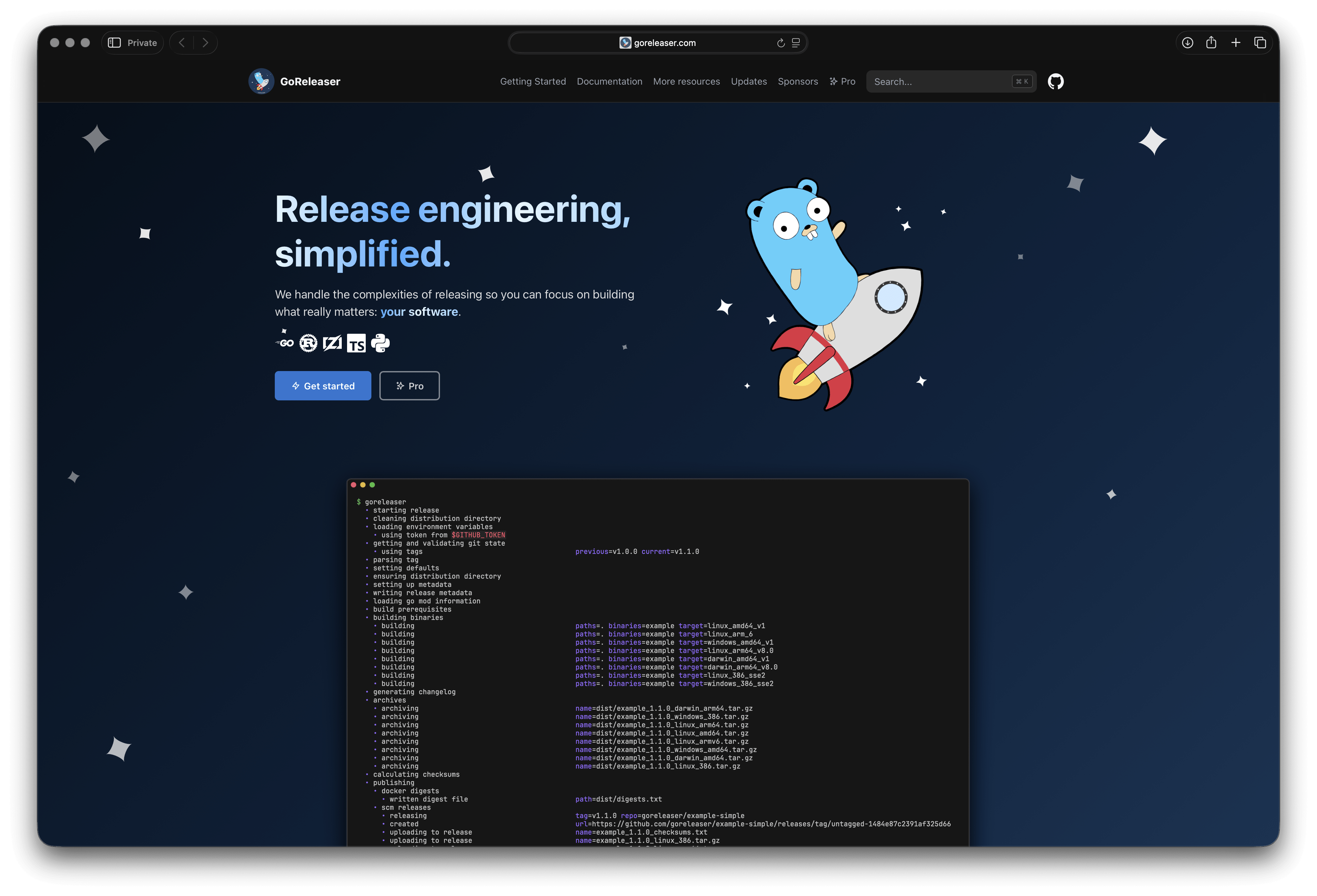
goreleaser.com
We migrated the documentation website from Material for MkDocs to Hugo with the Hextra theme.
The new site is faster, and we took the opportunity to clean up and improve the docs along the way.
If you run into any broken links, please let us know — or open a PR adding a
redirect to the _redirects file.
You can read the full announcement here.
Note These features are only available in the Pro plans.
The before_publish hook now works with NSIS and .pkg installer types, so
you can run scripts before those artifacts are published.
The SBOM pipe now covers installer types too — you can generate SBOMs for your
.pkg and NSIS installers alongside your binaries.
We also fixed a handful of rough edges left over from v2.14: NSIS and .pkg
artifacts are now correctly uploaded to releases and blob storage, play nicely
with the custom publisher, and are included when signing installers.
message_thread_id to post to a specific supergroup thread; fixed response body not being closed404 with exponential backoff--provenance and --sbom flags are available before using themcargo-zigbuild targets with custom glibc versionswindows/arm from valid build targetsignore_tags filtering when multiple tags are setYou can install or upgrade using your favorite package manager, or see the full release notes and download the pre-compiled binaries from GitHub:
You can help by reporting issues, contributing features, documentation improvements, and bug fixes. You can also sponsor the project, or get a GoReleaser Pro license.